
Leading Training: The Invisible Dialogue Through Body Language
Leading is far more than just walking from point A to point B. It is the first form of communication we establish with our horse. Here, the finest signals decide who sets the pace and how safely we move together. Good leading training is based on respect, trust, and clear body language.
1. The Golden Rule: Presence Over Power
Success in leading is based on an attentive and calm horse that accepts the human as a confident partner. Your shoulder position, core tension, and gaze determine the direction. A horse that pulls on the lead or is distracted often reflects unclear leadership. Only when communication through trust works on flat ground do course elements truly make sense as focus exercises.
2. Precision Through Structure: Your Training Course
Visual boundaries help you check your own body language and provide orientation for the horse:
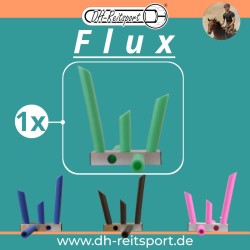
Flux: Lanes for Spatial Respect
Use Flux to set up a lane. This helps horses that tend to crowd the human. The lane marks your "comfort zone" and teaches the horse to respectfully maintain the necessary distance.
AgileWork: Slalom for Focus
A slalom with AgileWork demands full attention. Your horse learns to orient itself exactly to your shoulder and to stay concentrated with you even in turns. It strengthens the trust that you are leading the right way.
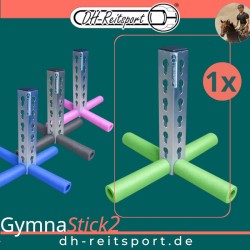
GymnaStick2: Consolidating the Stop Command
Use GymnaStick2 to mark precise stopping points. Practicing "point landings" sharpens the horse's reaction to your body language and creates discipline in a positive sense.
3. Step-by-Step to Leading Proficiency
- Claiming Space: The horse should always maintain a polite distance. Use Flux lanes to visualize this corridor.
- Synchronicity: Vary your pace. Your horse should slow down or stop with you like a shadow, without any tension on the lead rope.
- Backing Up: A vital element for trust and respect. A subtle cue or simply moving toward the horse should be enough.
Conclusion
Leading training is relationship work at eye level. Those who master body language create safety. With tools like Flux, AgileWork, and GymnaStick2, you give your training structure and make the progress in your partnership visible.
 Whatsapp
Related Products
-
Flux Jump Infill | Universal Talent & Pole Riser
Aluminum base profile Weatherproof, flexible insert parts (1.4m insert par...
-
Flux Jump Infill | Universal Talent & Pole Riser
Aluminum base profile Weatherproof, flexible insert parts (1.4m insert par...
-
GymnaStick2 Cavaletti Stand | Keyhole System
Our popular and versatile Cavaletti stand – now available with a second fo...