
The Letters in the Dressage Arena – Layout and Meaning Explained
The Letters in the Dressage Arena – Layout and Meaning Simply Explained
Anyone looking at a dressage arena for the first time often asks: Why are there letters like A, K, E, or H? And why does the order seem completely arbitrary at first glance?
In fact, the arrangement of dressage letters has historical roots and still serves a practical purpose today. It provides judges, trainers, and riders with clear orientation in the arena.
Why were these specific letters chosen?
The letters used today originally come from a 19th-century Prussian cavalry riding arena.
A common explanation is that along the riding track there were stables, buildings, spectator areas, and other facilities marked with letters. The riders used these markers for orientation. When standardized dressage arenas were created later, the familiar designations were adopted.
Although individual historical details are not fully proven, this origin is considered the most likely source of today's system.
What is the use of the dressage letters?
The letters serve for the precise description of movements and lines.
Examples:
- "Enter at A"
- "Halt and salute at X"
- "Circle at E"
- "Volte at B"
- "Transition at C"
This allows judges, trainers, and riders to know exactly where a movement is to be executed at any time.
Memory aid for riders
Many riders learn the sequence of letters using mnemonics. The main points are particularly important at first:
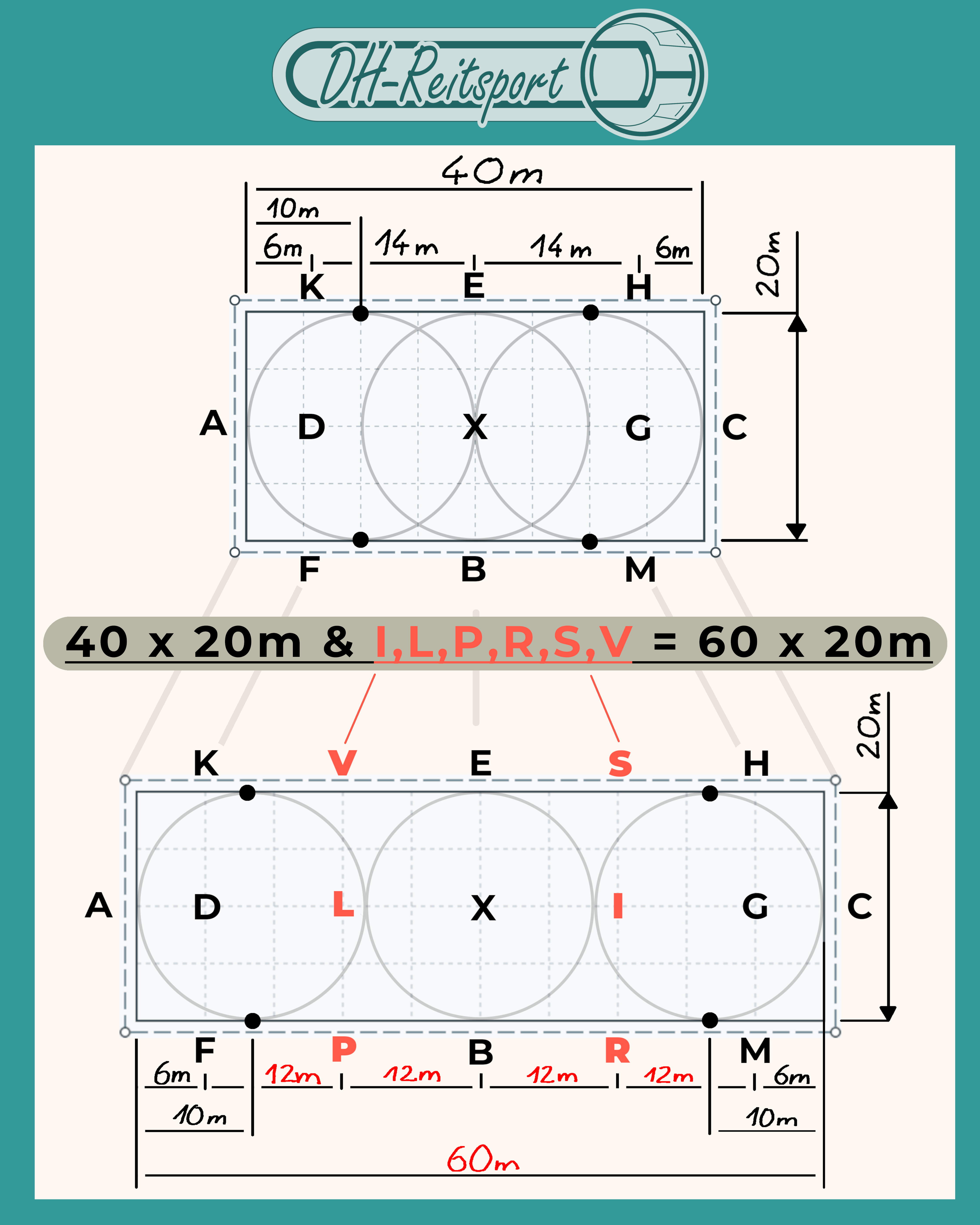
- A and C are located in the middle of the short sides.
- E and B mark the middle of the long sides.
- X is the center of the arena.
- K, H, M, and F are located between the corners and the middle of the sides.
Those who know these points securely can usually figure out the remaining letters quickly.
Conclusion
The letters in the dressage arena are no coincidence, but a historically grown orientation system. They enable clear communication between riders, trainers, and judges and form the basis of every dressage test. Once you have understood the system, you can navigate the dressage arena quickly and safely.
 Whatsapp